
What is Kratom and Why is It Raising Concerns?
Kratom has been a top news topic due to growing concerns about its potential for harm. It is relatively new and so many people, including some mental health professionals, may not be familiar with it or the risks patients may incur when they use it. The APA recently conducted a survey that found only 19% of U.S. adults were familiar with this substance. The 2023 National Survey on Drug Use & Health estimates 1.6 million annual users in the U.S. This post provides a brief overview of kratom, current concerns surrounding it, current legal status, and sources of additional information.
Kratom
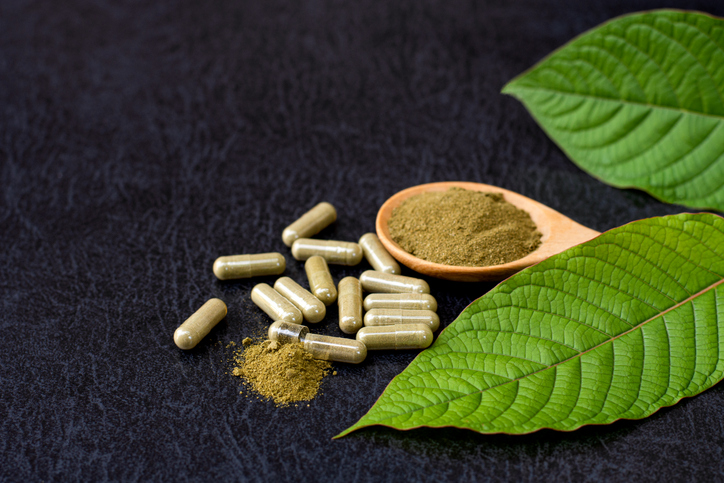
Kratom is a leafy plant native to southeast Asia, that has found popularity in the United States due its psychoactive properties. Its leaves can be prepared and consumed as a tea, capsule, tonic, or pressed tablet. Recently, concentrated preparations of opioids that are naturally produced by kratom have become commercially available, prompting concern from the medical community, FDA, and DEA, due to their potential for dependence and addiction.
What is an opioid?
Opioids are molecules with diverse shapes and structures that modulate opioid receptors. Our brains and bodies naturally produce opioid peptides, including endorphins, dynorphins, and enkephalins, among others, and these govern myriad central and peripheral neural circuits, such as motivation, pain, and gut motility. Other animals and some plants also produce opioids. These are frequently small molecules that happen to act on human opioid receptors – especially the mu opioid receptor, which is a key mediator of addiction and pain relief. Different opioid molecules exhibit wide differences in affinity for the mu receptor, as well as in how strongly they agonize (or antagonize) receptor activity.
Kratom’s opioids
The principal opioids produced by Kratom are mitragynine and 7-hydroxymitragynine (7-OH). These are naturally present in small amounts in kratom leaves. In laboratory testing, rodents have difficulty telling the difference between these molecules and morphine. Recently, widely available Kratom-derived products, including capsules, tonics, and pressed tablets, have increased the availability of concentrated, high potency 7-OH. Serious medical complications, including overdose and death, have been linked to Kratom and derivatives – both by themselves and when used in combination with other substances. The isolated risk of each molecule versus their contribution to polysubstance overdose has not been systematically described.
Legal Status
Despite long-standing data describing the opioid activity of kratom, it remains widely accessible. FDA policy has consistently banned kratom from human consumption, yet, enforcement has been inconsistent, with kratom product manufacturers even being official sponsors of high-visibility college sports teams. The DEA proposed listing Kratom derivatives as Schedule 1 substances in 2016 but quickly rescinded this proposal, after pressure from industry, constituents, and legislators. It remains unscheduled today.
Recently, the FDA has proposed scheduling products containing 7-OH above a certain concentration, but the DEA has yet to act on this request. The FDA has not requested that kratom itself be scheduled. Regulation at the state level varies, with some states banning kratom, some restricting its purchase, and others without any regulatory framework. Internationally, kratom is illegal in several European and Asian countries.
Problems & Treatment
As it contains opioids, kratom has the potential for dependence and addiction. Kratom-related fatal overdoses, including polysubstance overdose, as well as naloxone (Narcan)-responsive overdoses, are increasingly reported. Fatal opioid overdoses involving kratom increased from 0.5% of all opioid-related deaths in 2016 to 2% in 2022.
People who use kratom regularly are likely to develop dependence, while people who are kratom dependent and stop using Kratom are likely to experience opioid withdrawal. There is no definitive guideline for the treatment of kratom dependence. Many clinicians manage kratom dependence similarly to dependence of other opioids, using combinations of medications and behavioral interventions. Small studies have shown positive outcomes using medications for opioid use disorder (MOUD), including buprenorphine, methadone, and naltrexone. As the FDA has recently stated definitively that 7-OH is an opioid, a formal declaration from HHS to this effect will be helpful in ensuring proper diagnosis and access to treatment for this patient population.
Kratom overdoses should be treated as opioid overdoses, including the administration of naloxone, followed by immediately calling 911. Patients using kratom should be educated about the potential for dependence, addiction, and overdose. They should be trained in the use of naloxone and carry it with them. Kratom should not be mixed with other substances.
Mental health professionals can help their patients by educating them on the risks of kratom and derivative use, identifying patients with dependence or addiction, and providing treatment or referral to an addiction specialist.
Outlook
Kratom and its opioid derivatives are widely available, with the potential for dependence and addiction. There are limited data to describe long-term health hazards or optimal treatment for kratom users. It is critical for both primary and specialty clinicians to be aware of this substance and to include it in routine substance use disorder screening.
Resources
NIDA: Kratom
https://nida.nih.gov/research-topics/kratom
FDA: FDA and Kratom
https://www.fda.gov/news-events/public-health-focus/fda-and-kratom
ASAM Learning: Kratom: Emerging Findings and Treatment Considerations such as MI and Medication Strategies
https://elearning.asam.org/products/kratom-emerging-findings-and-treatment-considerations-such-as-mi-and-medication-strategies
ASAM learning: The Associations of Kratom (Mitragynine), Opioids, Other Substances, and Sociodemographic Variables to Drug Intoxication-related Mortality
https://elearning.asam.org/products/the-associations-of-kratom-mitragynine-opioids-other-substances-and-sociodemographic-variables-to-drug-intoxication-related-mortality
ASAM Learning: Prevalence of Kratom Use Disorder among Kratom Consumers
https://elearning.asam.org/products/prevalence-of-kratom-use-disorder-among-kratom-consumers
PCSS: Best Practices in Managing Patients with Kratom Addiction
https://pcssnow.org/wp-content/uploads/2020/09/KRATOM-webinar-PCSS-2020-final-version-9.28.20-1.pdf
FDA: Letter from FDA Commissioner to healthcare professionals
https://www.fda.gov/media/187898/download?attachment
FDA: 7-Hydroxymitragynine (7-OH): An Assessment of the Scientific Data and Toxicological Concerns Around an Emerging Opioid Threat
https://www.fda.gov/media/187899/download?attachment
References
- Substance Abuse and Mental Health Services Administration. (2023). 2023 National Survey on Drug Use and Health (NSDUH): DAS crosstab (AGE3 × KRATOMYR) [Data table]. https://datatools.samhsa.gov/das/nsduh/2023/nsduh-2023-ds0001/crosstab?row=AGE3&column=KRATOMYR&weight=ANALWT2_C
- American Medical Association. (n.d.). Kratom (Policy H-95.903). https://policysearch.ama-assn.org/policyfinder/detail/kratom?uri=%2FAMADoc%2FHOD.xml-H-95.903.xml
- U.S. Food and Drug Administration. (n.d.). FDA and kratom. https://www.fda.gov/news-events/public-health-focus/fda-and-kratom
- U.S. Drug Enforcement Administration. (n.d.). Kratom (Drug fact sheet). https://www.dea.gov/factsheets/kratom
- Harun, N., et al. (2015). Discriminative stimulus properties of mitragynine (kratom) in rats. Psychopharmacology, 232(13), 2227–2238. https://pubmed.ncbi.nlm.nih.gov/25616583/
- National Institute on Drug Abuse. (n.d.). Kratom. https://nida.nih.gov/research-topics/kratom#safe
- Grundmann, O., et al. (2024). Commentary: Presence of kratom in opioid overdose deaths: Findings from coroner postmortem toxicological report. Frontiers in Psychiatry, 15, 1411964. https://www.frontiersin.org/journals/psychiatry/articles/10.3389/fpsyt.2024.1411964/full
- Final draft of “Dear Colleague” Senate letter to the head of the DEA regarding kratom. (n.d.). Scribd. https://www.scribd.com/document/326301307/Final-Draft-of-Dear-Colleague-Senate-Letter-to-the-Head-of-the-DEA-Regarding-Kratom
- Album 0RI1V [Image album]. (n.d.). Imgur. https://imgur.com/a/0RI1V
- DEA-2016-0015-0006—Comment. (n.d.). Regulations.gov. https://www.regulations.gov/document/DEA-2016-0015-0006/comment
- U.S. Food and Drug Administration. (n.d.). FDA takes steps to restrict 7-OH opioid products threatening American consumers [Press release]. https://www.fda.gov/news-events/press-announcements/fda-takes-steps-restrict-7-oh-opioid-products-threatening-american-consumers
- Overbeek, D. L., Abraham, J., & Munzer, B. W. (2019). Kratom (mitragynine) ingestion requiring naloxone reversal. Clinical Practice and Cases in Emergency Medicine, 3(1), 24. https://pubmed.ncbi.nlm.nih.gov/30775658/
- Olsen, E. O. (2019). Notes from the field: Unintentional drug overdose deaths with kratom detected—27 states, July 2016–December 2017. MMWR. Morbidity and Mortality Weekly Report, 68. https://www.cdc.gov/mmwr/volumes/68/wr/mm6814a2.htm
- Centers for Disease Control and Prevention. (n.d.). SUDORS fatal overdose data dashboard. https://www.cdc.gov/overdose-prevention/data-research/facts-stats/sudors-dashboard-fatal-overdose-data.html
- Rogers, J. M., et al. (2024). Kratom addiction per DSM-5 SUD criteria, and kratom physical dependence: Insights from dosing amount versus frequency. Drug and Alcohol Dependence, 260, 111329. https://pubmed.ncbi.nlm.nih.gov/38788532/