
To Be in the Moment
I recently switched to an Apple Watch from my Garmin Sport watch, and as most Apple Watch users know, you have to charge it essentially every day. Conversely, for my Garmin, it’s every 2-3 weeks. After making the switch, I had a sudden realization that when I didn’t have a watch on (because it was charging), I was free. Free from notifications. Free from the lingering feeling that someone might be about to contact me. And it was just nice being present with my kids and wife, who were right there in front of me. I was free to just play with my kids. It is these little moments that remind me that this is the important part, to be right here, right now.
And that is exactly what meditation and mindfulness have afforded me: the luxury to recognize and be present for these little moments. It turns out that these little moments where I notice my attention and can be fully present for the things that matter are the goal of meditation and mindfulness.
It got me thinking about a recently injured NBA player, Victor “Wemby” Wembanyama, who took a retreat to the Shaolin temple to train in meditation, among other things. For Wemby to go to those lengths to train mentally spoke to my soul.
Meditation and mindfulness
Though I’ve been a practitioner of medication and mindfulness for many years, I still remember the very beginning, with the unbearable silence to be present in my own head and body. Even now It usually goes something like this graph:
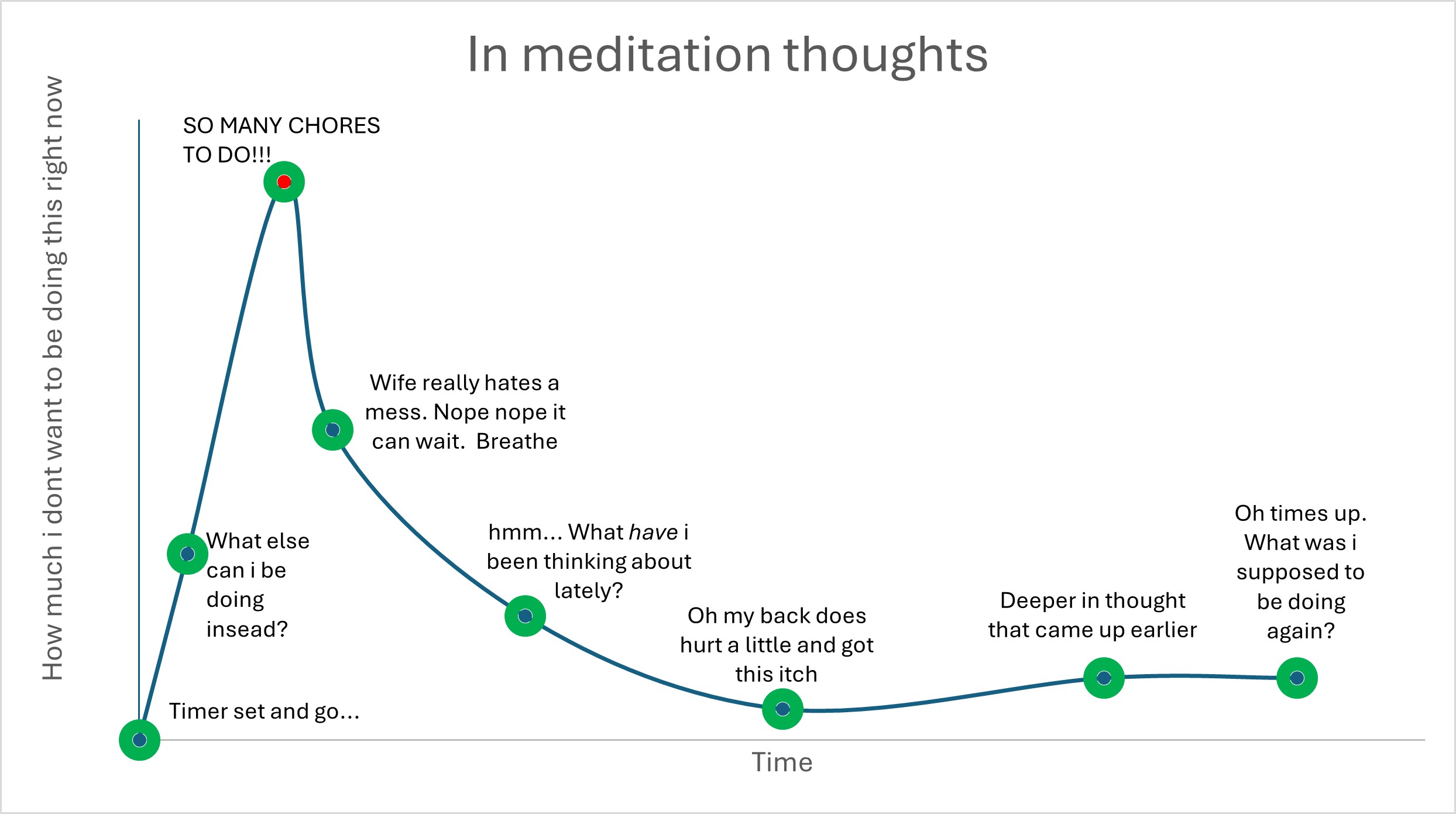
Turns out that this is the norm. I have had the luxury of calling the University of Wisconsin-Madison my alma mater, and we have our very own Director of Meditation training for our NCAA Division I athletics (the first of his kind). He started mindfulness practices with former NFL players, and they realized it’s hard to sit still and notice their own thoughts. He took to research and found that after female NCAA division I athletes underwent mindfulness training for 6 weeks, the day after a mindfulness practice day, they had a staggering reduction of acute injury of 58%1. Granted, it was a small population of 21 athletes, so there is more room for further research, but it's still compelling.
Now, how does this work? The short answer is that we think it’s because mindfulness practices increase your awareness of your body, your thoughts, and your thoughts about your thoughts (meta-awareness). This awareness of your attention is the key, as it allows you to be able to redirect your attention to make better decisions.
Cognitive behavioral therapy
There is an important mental health connection with all of this. For treating mental health conditions, including major depressive disorder, generalized anxiety disorder, posttraumatic stress disorder (PTSD), and eating disorders, one of the most well-established treatments is cognitive behavioral therapy. A key part of cognitive behavioral therapy is mindfulness.
The best way I can describe cognitive behavioral therapy is that it’s a structured talk therapy that helps make you aware of maladaptive thought patterns. Once aware, you can start to modify or re-interpret these thoughts. The idea is that when you are aware of troubling habits, you can notice when they are coming and prepare to alter the course of that habit.
Awareness is the key, both in your life and on the playing field. It’s that very moment of awareness when you can ask yourself, “What are my options to deal with this right now?”
Tips for a Mindful Life
I’ll leave you with some practical pieces of advice for living a more mindful life:
- Start with guided meditation, my favorite being the Healthy Minds app (App store; Google Play). Many other options are available, too.
- Come to terms that the beginning is going to be uncomfortable.
- Even one undistracted long breath is a success.
- Every time you reach for your phone, just notice that you are.
With practice of the above items, I bet you will start to notice little moments of choice entering your life, where before there might have been automatic and unmindful action. Good luck and have fun!
By
Moua Lee, 4th year medical student
University of Wisconsin School of Medicine and Public Health
Reviewed by
Claudia L. Reardon, M.D., Professor
University of Wisconsin School of Medicine and Public Health Department of Psychiatry
References
- Haraldsdottir K, Sanfilippo J, Anderson S, et al. (2024). Mindfulness Practice Is Associated With Improved Well-Being and Reduced Injury Risk in Female NCAA Division I Athletes. Sports Health. 2024 Mar-Apr;16(2):295-299. doi: 10.1177/19417381241227447.