Anxiety disorders are common mental health conditions that involve excessive fear, worry, or nervousness that interfere with daily life. While occasional anxiety is a normal part of life, anxiety disorders are more persistent, harder to control, and can affect relationships, work, and overall well-being.
These conditions are among the most common mental health disorders across the lifespan, affecting both children and adults. Estimates suggest that up to one in three people may experience an anxiety disorder at some point in their lives (American Psychiatric Association, 2022).
Anxiety is different from fear. Fear is a response to an immediate threat, while anxiety refers to anticipation of a future concern. Anxiety is often associated with muscle tension and avoidance behaviors, whereas fear is linked to a “fight-or-flight” response.
Symptoms can vary depending on the type of anxiety disorder, but often include:
- Emotional symptoms:
- Persistent worry or fear
- Feeling “on edge” or restless
- Difficulty concentrating
- Physical symptoms:
- Rapid heartbeat or shortness of breath
- Muscle tension
- Fatigue
- Sleep disturbances
- Behavioral symptoms:
- Avoiding feared situations
- Reassurance-seeking
- Difficulty completing daily tasks
For a diagnosis of an anxiety disorder, the symptoms must be out of proportion to the situation, persistent, and interfere with daily functioning. Some anxiety disorders typically begin in childhood; others emerge later in adolescence or adulthood.
As identified in the Diagnostic and Statistical Manual of Mental Disorders (DSM-5-TR), anxiety disorders include the following.
Generalized Anxiety Disorder (GAD) involves ongoing and excessive worry about several everyday situations (e.g., health, finances, work), often accompanied by restlessness, fatigue, feeling on edge, muscle tension, or sleep problems.
People with panic disorder experience repeated, unexpected panic attacks, which consist of sudden episodes of intense fear with physical symptoms such as chest pain, shortness of breath, dizziness, shaking, or heart palpitations. Because symptoms can be intense, some people experiencing a panic attack may believe they are having a heart attack and seek emergency care.
Panic attacks may be expected, such as a response to a feared object, or unexpected, apparently occurring for no reason. The mean age for onset of panic disorder is 20-24. Panic attacks may occur with other mental disorders such as depression or PTSD.
|
Panic Disorder Symptoms During an attack, several of these symptoms occur in combination |
|
|---|---|
| Palpitations, pounding heart or rapid heart rate | Numbness or tingling |
| Sweating | Chills or hot flashes |
| Trembling or shaking | Nausea or abdominal pains |
| Feeling of shortness of breath or smothering sensations | Feeling detached |
| Chest pain | Fear of losing control |
| Feeling dizzy, light-headed or faint | Fear of dying |
| Feeling of choking | |
Specific phobias involve a person experiencing an excessive and persistent fear of a specific object, situation or activity that is generally not harmful. The person knows their fear is excessive, but the feeling is overwhelming.
These fears cause such distress that some people go to extreme lengths to avoid what they fear. Examples include fear of public speaking, heights, flying, injections, and spiders.
Agoraphobia involves extreme fear of situations where escape may be difficult or embarrassing, or help may not be available in the event of panic symptoms. The fear is out of proportion to the actual situation and lasts generally six months or more and causes problems in functioning.
A person with agoraphobia experiences this fear in two or more of the following situations:
- Using public transportation
- Being in open spaces
- Being in enclosed places
- Standing in line or being in a crowd
- Being outside the home alone
The individual actively avoids the situation, requires a companion or endures with intense fear or anxiety. Untreated agoraphobia can become so serious that a person may be unable to leave the house. A person can only be diagnosed with agoraphobia if the fear is intensely upsetting or if it significantly interferes with normal daily activities.
Social Anxiety Disorder (or Social Phobia) involves a person experiencing an intense fear of being judged, embarrassed, or rejected in social or performance situations.
A person with social anxiety disorder has significant anxiety and discomfort about being embarrassed, humiliated, rejected or looked down on in social interactions. People with this disorder will try to avoid the situation or endure it with great anxiety. Common examples are extreme fear of public speaking, meeting new people or eating/drinking in public. The fear or anxiety causes problems with daily functioning and lasts at least six months.
Separation Anxiety Disorder involves an excessive fear about being separated from attachment figures. It can occur in both children and adults.
A person with separation anxiety disorder is excessively fearful or anxious about separation from those with whom they are attached. The feeling is beyond what is appropriate for the person's age, persists (at least four weeks in children and six months in adults) and causes problems functioning. A person with separation anxiety disorder may be persistently worried about losing the person closest to him or her, may be reluctant or refuse to go out or sleep away from home or without that person, or may experience nightmares about separation. Physical symptoms of distress often develop in childhood, but symptoms can carry though adulthood.
Selective Mutism is a condition in which a child is unable to speak in certain social situations despite speaking normally in others.
Children with selective mutism do not speak in some social situations where they are expected to speak, such as school, even though they speak in other situations. They will speak in their home around immediate family members, but often will not speak even in front of others, such as close friends or grandparents.
The lack of speech may interfere with social communication, although children with this disorder sometimes use non-spoken or nonverbal means (e.g., grunting, pointing, writing). The lack of speech can also have significant consequences in school, leading to academic problems and social isolation. Many children with selective mutism also experience excessive shyness, fear of social embarrassment and high social anxiety. However, they typically have normal language skills.
Selective mutism usually begins before age 5, but it may not be formally identified until the child enters school. Many children will outgrow selective mutism. For children who also have social anxiety disorder, selective mutism may disappear, but symptoms of social anxiety disorder may remain.
What Causes Anxiety Disorders? Anxiety disorders develop from a combination of biological, psychological, and environmental factors. Common risk factors include:
- Genetics and family history
- Anxiety can run in families
- Early life experiences
- Childhood anxiety or behavioral patterns
- Trauma, stress, or separation experiences
- Personality and temperament
- High sensitivity to stress
- Tendency toward negative emotions
- Environmental stressors
- Chronic stress
- Medical illness or substance use
Anxiety disorders are among the most common mental health conditions. In adults, about 5–10% experience an anxiety disorder in a given year, and lifetime risk may reach 10–30% depending on the population studied (Kessler et al., 2012; Baxter et al., 2013).
Different types of anxiety disorders vary in how common they are. (See table.) In children and adolescents, anxiety disorders are also common. Specific phobias and separation anxiety disorder being among the most frequent in younger populations.
Anxiety disorders are more common in women than in men. They frequently occur alongside other conditions such as depression, ADHD, or substance use disorders.
| Disorder | Population | Lifetime Prevalence |
Past-year |
|---|---|---|---|
| Any Anxiety Disorder | adults | 31.1% | 19.1% |
| adolescents | 31.9% | --- | |
| Generalized Anxiety Disorder | adults | 5.7% | 2.7% |
| adolescents | --- | 2.2% | |
| Specific Phobia | adults | 12.5% | 9.1% |
| adolescents | 19.3% | --- | |
| Panic Disorder | adults | 4.7% | 2.7% |
| adolescents | 2.3% | --- | |
| Social Anxiety Disorder | adults | 12.1% | 7.1% |
| adolescents | 9.1% | --- | |
| Separation Anxiety Disorder | adolescents | 7.6% | --- |
Source for separation anxiety: Merinkangas, et al. 2010
Source of all others: NIMH, Mental Health Topics: Statistics
The first step is often to see your doctor to rule out medical conditions that may cause similar symptoms. A diagnosis is made by a qualified health professional.
Anxiety disorders are treatable, and many people improve with appropriate care.
1. Psychotherapy (talk therapy)
Cognitive behavioral therapy (CBT) is a first-line treatment for many anxiety disorders in both children and adults. CBT can help individuals:
- Identify and change unhelpful thought patterns
- Gradually face feared situations
- Build coping skills
2. Medications
Medications will not cure anxiety disorders but can provide significant relief from symptoms. First-line medications for many anxiety disorders include selective serotonin reuptake inhibitors (SSRIs) and serotonin-norepinephrine reuptake inhibitors (SNRIs). These medications are helpful in reducing anxiety symptoms and are often used alone or in combination with psychotherapy. Therapy alone can be an effective treatment for mild cases of anxiety disorders. For more moderate to severe cases — among adults and children — medications such as SSRIs or SNRIs are appropriate.
3. Living With Anxiety and Lifestyle and Self-Management
Anxiety disorders can affect many areas of life, including work, school, and relationships. However, with treatment and support, many people experience meaningful improvement. Healthy habits can support recovery:
Healthy habits can support recover:
- Regular physical activity
- Adequate sleep
- Mindfulness or relaxation practices
- Limit caffeine and stimulants
- Join support groups (in-person or online)
- Learn about your condition to better manage symptoms
Some complementary approaches, such as yoga, may help reduce anxiety symptoms, although they are best used alongside evidence-based treatments. Some supplements may be considered to help with anxiety symptoms, but it is essential to consult with your physician before starting any new supplement regimen.
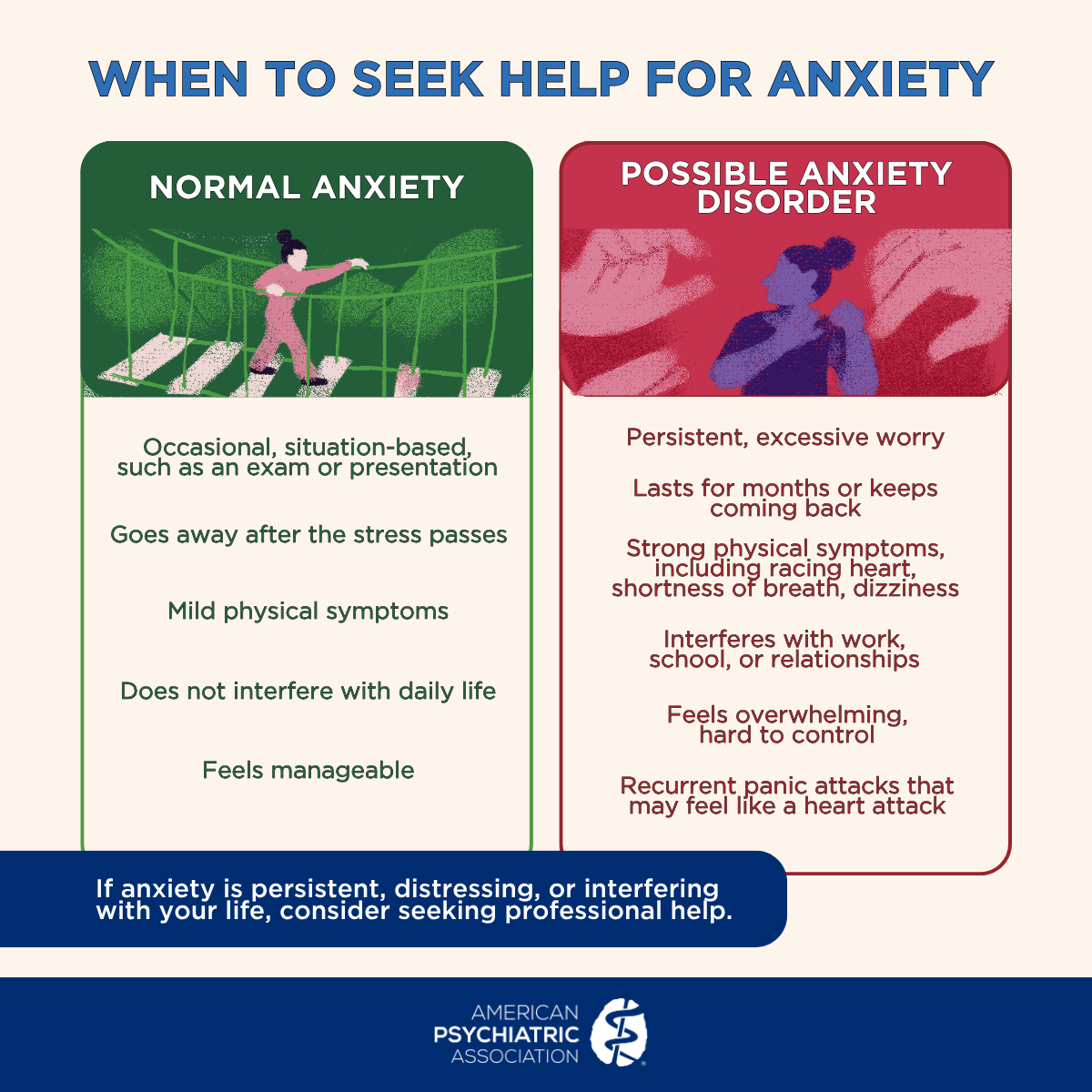
|
When to Seek Help for Anxiety |
|
|---|---|
| Normal Stress | Potental anxiety disorder |
| Occasional, situation-based (e.g., exam, presentation) | Persistent, excessive worry |
| Goes away after stress passes | Lasts for months or keepscoming back |
| Mild physical symptoms | Strong physical symptoms (racing heart rate, shortness of breath, dizziness) |
| Does not interfere with daily life | Interferes with work, school, or relationships |
| Feels manageable | Feels overwhelming, hard to control |
| Recurrent panic attacks; may feel like a heart attack | |
- Posttraumatic stress disorder (PTSD)
- Acute stress disorder
- Obsessive-compulsive disorder
- Adjustment disorder
Physician Review
Judith A. Gutierrez, M.D., M.P.H.
Josepha Immanuel, M.D., FAPA
May 2026
- American Psychiatric Association. (2022). Diagnostic and statistical manual of mental disorders (5th ed., text rev.; DSM-5-TR). American Psychiatric Association Publishing.
- Bandelow, B., Michaelis, S., & Wedekind, D. (2017). Treatment of anxiety disorders. Dialogues in Clinical Neuroscience, 19(2), 93–107. https://pubmed.ncbi.nlm.nih.gov/28867934/
- Baxter, A. J., Scott, K. M., Vos, T., & Whiteford, H. A. (2013). Global prevalence of anxiety disorders: A systematic review and meta-regression. Psychological Medicine, 43(5), 897–910.
- Kessler, R. C., Petukhova, M., Sampson, N. A., et al. (2012). Twelve-month and lifetime prevalence and lifetime morbid risk of anxiety and mood disorders in the United States. International Journal of Methods in Psychiatric Research, 21(3), 169–184. https://doi.org/10.1002/mpr.1359
- Merikangas, K. R., He, J.-P., Burstein, M., Swanson, S. A., et al. (2010). Lifetime prevalence of mental disorders in U.S. adolescents: Results from the National Comorbidity Survey Replication–Adolescent Supplement (NCS-A). Journal of the American Academy of Child & Adolescent Psychiatry, 49(10), 980–989. https://pubmed.ncbi.nlm.nih.gov/20855043/
- National Institute of Mental Health. (n.d.) Mental Health Topics: Statistics. https://www.nimh.nih.gov/health/statistics